Taken from http://images.allposters.com/images/84/039_47621.jpg
Michelle Yeoh
Achievements
-entered the London Royal Academy of Dance, majoring in Ballet - (Following a spinal injury, her dreams of becoming a ballerina was cut short and she never did get a chance to perform ballet professionally onstage.) - Received a B.A. degree in Creative Arts and a minor in Drama - In 1983, Michelle was crowned Miss Malaysia at the age of 21 - Did her first few commercials with action star Jackie Chan and Chow Yun Fat for a brand of watches owned by a Hong Kong business man named Dickson Poon (future husband). - Offered a film contract by Dickson Poon in his newly founded film production company, D&B Films. - Starred in her first movie, The Owl vs Dumbo—an action comedy by Sammo Hung - Second major screen appearance in 1985, playing a fearless policewoman in Yes, Madam. She also performed her first major stunt in this movie, which involved her flipping backwards on a railing and smashing her head through glass while simultaneously throwing two thugs off the balcony. - In February 1988, Michelle got married to Dickson Poon, and retired from acting at her billionaire husband’s request. - However, little more than 3 years later, they divorced amicably and remained as friends. - Continued starring in movies such as Super Cop (1992), Tomorrow Never Dies (1997), Crouching Tiger, Hidden Dragon (2000), Memoirs of a Geisha (2005), and The Mummy: The Tomb of the Dragon Emperor (2008). - In 2000, she started her own film production company, “Mythical Films”, and released a film, entitled, The Touch in August 2002. - In 2009, she released a documentary entitled Turning Point- A Journey on the World’s Killer Roads, in conjunction with her campaign as global ambassador for the Make Roads Safe programme.
Awards - Achievement Award, Marrakech International Film Festival, 2008 - Chevalier de Legion d'Honneur, France, 2007 - The Asian Film Award, MTV Asia, 2004 - International Actor of The Year, MTV & SMG Style Awards (China), 2003 - Producer of the Year Award, CineAsia, 2002 - The Outstanding Young Persons of the World (Cultural Achievement), 2002 - The Outstanding Young Malaysian Awards, 2002 - Montblanc Arts Patronage Award (Hong Kong Winner), 2002 - Datuk Paduka Mahkota Perak Award, Malaysia, 2001 - International Star of the Year Award, ShoWest, 2001 - Best Film Actress, Ethnic Multicultural Media Awards (EMMA), 2001 - Best Actress in a Cinematic Production, Ammy Awards, 2001 - Award of Excellence in Acting, CineAsia, 1999
Contributions - During her one year term as Miss Malaysia, she served the community, similar to being a goodwill ambassador for her country. - Her ability to perform daredevil stunts in Yes, Madam allowed for a breakthrough in the entertainment industry, thereby marking the birth of the Girls with Guns genre. - In 2008, she became a global ambassador for the Make Roads Safe campaign, travelling to different regions in Asia, Africa and Latin America to promote global road safety. - Ambassador to amfAr AIDS Research - Governor to LoveFaithHope Charitable Foundation, Hong Kong - Ambassador to Force of Nature Aid Foundation, Malaysia - Patron to Aids Concern, Hong Kong - Patron to the Hong Kong Cancer Fund - Ambassador to Mercy Malaysia, Malaysia - Ambassador to Institute for Cerebral and Medullary Disorders, France
-entered the London Royal Academy of Dance, majoring in Ballet - (Following a spinal injury, her dreams of becoming a ballerina was cut short and she never did get a chance to perform ballet professionally onstage.) - Received a B.A. degree in Creative Arts and a minor in Drama - In 1983, Michelle was crowned Miss Malaysia at the age of 21 - Did her first few commercials with action star Jackie Chan and Chow Yun Fat for a brand of watches owned by a Hong Kong business man named Dickson Poon (future husband). - Offered a film contract by Dickson Poon in his newly founded film production company, D&B Films. - Starred in her first movie, The Owl vs Dumbo—an action comedy by Sammo Hung - Second major screen appearance in 1985, playing a fearless policewoman in Yes, Madam. She also performed her first major stunt in this movie, which involved her flipping backwards on a railing and smashing her head through glass while simultaneously throwing two thugs off the balcony. - In February 1988, Michelle got married to Dickson Poon, and retired from acting at her billionaire husband’s request. - However, little more than 3 years later, they divorced amicably and remained as friends. - Continued starring in movies such as Super Cop (1992), Tomorrow Never Dies (1997), Crouching Tiger, Hidden Dragon (2000), Memoirs of a Geisha (2005), and The Mummy: The Tomb of the Dragon Emperor (2008). - In 2000, she started her own film production company, “Mythical Films”, and released a film, entitled, The Touch in August 2002. - In 2009, she released a documentary entitled Turning Point- A Journey on the World’s Killer Roads, in conjunction with her campaign as global ambassador for the Make Roads Safe programme.
Awards
- Achievement Award, Marrakech International Film Festival, 2008 - Chevalier de Legion d'Honneur, France, 2007 - The Asian Film Award, MTV Asia, 2004 - International Actor of The Year, MTV & SMG Style Awards (China), 2003 - Producer of the Year Award, CineAsia, 2002 - The Outstanding Young Persons of the World (Cultural Achievement), 2002 - The Outstanding Young Malaysian Awards, 2002 - Montblanc Arts Patronage Award (Hong Kong Winner), 2002 - Datuk Paduka Mahkota Perak Award, Malaysia, 2001 - International Star of the Year Award, ShoWest, 2001 - Best Film Actress, Ethnic Multicultural Media Awards (EMMA), 2001 - Best Actress in a Cinematic Production, Ammy Awards, 2001 - Award of Excellence in Acting, CineAsia, 1999
Contributions
-During her one year term as Miss Malaysia, she served the community, similar to being a goodwill ambassador for her country. -Her ability to perform daredevil stunts in Yes, Madam allowed for a breakthrough in the entertainment industry, thereby marking the birth of the Girls with Guns genre. -In 2008, she became a global ambassador for the Make Roads Safe campaign, travelling to different regions in Asia, Africa and Latin America to promote global road safety. -Ambassador to amfAr AIDS Research -Governor to LoveFaithHope Charitable Foundation, Hong Kong -Ambassador to Force of Nature Aid Foundation, Malaysia -Patron to Aids Concern, Hong Kong -Patron to the Hong Kong Cancer Fund -Ambassador to Mercy Malaysia, Malaysia -Ambassador to Institute for Cerebral and Medullary Disorders, France
Today, we had to research for some SEA rice dishes which were specifically from Laos. Rice is extremely essential towards the lives of many citizens in Southeast Asian countries (e.g. Indonesia, Thailand). In fact, many of these countries practice wet rice farming, as this not only contributes to a stable source of staple food, but also offers agricultural labour and job opportunities to the citizens. Although Singapore does not emphasize much on farming, much less practise it, we are dependent on other countries for these crops and fresh produce of rice. Furthermore, rice plays an important role in defining the culture of our cuisine, as rice is commonly associated to be a necessary/must-have ingredient in most SEA food.
Through some research, me and the rest of my Laos group managed to find a good deal of Laos recipes involving rice. An observation which we made while surfing for sites was that many of the websites were not just about Laos food, but also covered aspects of Thai food, some of which were quite similar to those in Laos food. For example, they were both largely spicy, as shown in this particular dish: popular Lao food is called "Tum Mak Hung" (more commonly known as "Tum Som" in Laos or "Som Tum" in Thailand. Eventually, we found out that the similarities between cuisines were caused because many Laotians used to live in the mountaineous regions of Thailand, simultaneously introducing new culture and dishes.
1. Sticky Rice/ Sticky Rice and Sauce
Recipe: Sticky Rice
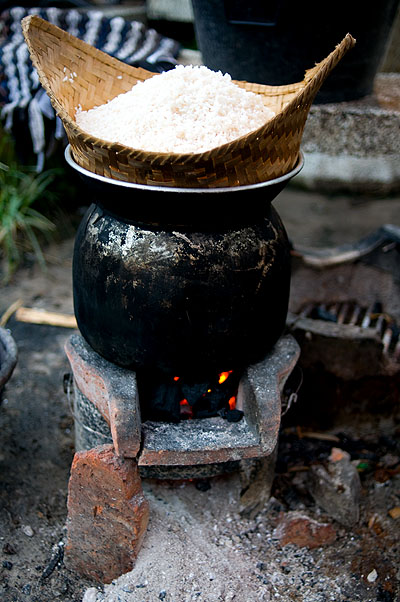
1. Rinse the glutinous rice several times to remove any debris. 2. Soak the rice in luke warm water for at least 4 hours or over night. 3. Pour soaked rice into a bamboo steaming basket. If there are any left over sticky rice, separate them into little pieces and dropped on top of the soaked rice. Cover the rice with a lid. 4. Add 2 inches of water into the steaming pot. 5. Place the bamboo steaming basket into the pot. 6. Once the water boils, start cooking time for 20 minutes. 7. Carefully remove the steaming basket from the pot and flip the rice. 8. Cook for another 5 minutes. 9. Mix the rice thoroughly. 10. Serve sticky rice in a bamboo basket, as seen in the picture below.
Sticky Rice is the foundation of all Lao meals, and most Laotians prefer the glutinous sticky rice to the ordinary white cooked rice. This rice is usually served with sticky rice dipping sauces (e.g. Roasted Tomato Chili Sauce, Classic Thai / Lao Hot Sauce, Eggplant Chili Sauce, Jeow Ba Dek AKA Lao National Dipping Sauce) or Lap Lao Beef, a salad dip with meat and Thai/Lao herbs.
Video showing how Lap Lao Beef is cooked
2. Sticky rice in a snack!
Recipe: Grilling Sticky Rice with Egg
1 egg ¼ cup cooked white Thai / Lao sticky rice sprinkle of salt
Scramble the egg in a small bowl. Take cooked sticky rice, spread flat and sprinkle salt. Knead the rice to incorporate salt and make unto a round pattie. Grill the sticky rice over a barbeque or cast iron grill on high heat. Grill for one minute. Flip sticky rice over and spread one tablespoon of scrambled egg over rice. After one minute flip the sticky rice and spread egg over rice again. After one minute, flip the rice to cook the egg. Serve immediately or repeat by flipping and spreading more eggs over sticky rice.
Video showing how sticky rice with egg is grilled
3. Sticky Rice in dessert!
Dessert Recipe: Sticky Rice & Mango
1 cup fresh coconut milk 1/4 to 1/2 cup sugar 3 cups cooked sticky rice 1 ripe mango
In a pot, over medium heat, add coconut and sugar. Stir until sugar dissolves. Add sticky rice and stir until fresh coconut milk absorbs into sticky rice. Remove from heat and cool to room temperature. Remove skin of mango, cut into bit size pieces and discard the mango pit. Dish sticky rice on to a serving bowl or plate. Add mango slices over rice and serve.
Identify the common features that can be found in most SEA countries
1) Rice is a staple - food - agriculture - e.g. Thailand, Philippines, Laos, Cambodia, Malaysia
2) Experience of colonialism, with the exception of Thailand
3) Belong to ASEAN as a political group
4) Emphasis on art/aesthetics as an integral part of culture - e.g. Philippines(Filippinos are expected to be able to play the guitar) - e.g. Timor Leste (dance)
7) Environment - Largely forested - Dense Vegetation - Rainforests, Mangroves, River (adds to the beautiful scenery) - except for urbanised countries like Singapore.
8) Poverty - A grave issue which alot of SEA countries are grappling with
Those in bold are the features which we'll be studying in USEA lessons! :)
0 comments
Friday, April 24, 2009 6:23 PM
CULTURE
The culture of Laos has been highly influenced by Theravada Buddhism and neighboring countries such as Cambodia, Thailand and India. This influence is reflected throughout Laos in its language as well as in art, literature and the performing arts.
Laotian music is dominated by its national instrument, the khaen (a type of bamboo pipe). Bands typically include a singer/rapper (mor lam) and a khaen player (mor khaen) alongside fiddlers and other musicians. Lam saravane is the most popular genre of Laotian music, but ethnic Lao in Thailand have developed an internationally-best selling form called mor lam sing.
One significant archive of ancient Laotian culture is the Plain of Jars in Xieng Khouang province. Situated in the remote north east of Laos, the mountainous communist country which has only been open to tourists for just over a decade, are hundreds of huge stone jars scattered across several square miles. While most ancient Asian sites, such as the Angkor temples in Cambodia, have revealed many of their secrets, historians are still completely baffled as to where the jars came from, how old they are and what they signify.
The Language of Laos may seem similar to the Thai language to the untrained ear, but they are actually very different. Although most Laotian people will understand spoken and written Thai and even speak Thai, most Thai people outside of Issan (North East Thailand) do not understand Lao. The writing of the two languages is also rather different and therefore, very few Thai read Lao. The main similarity in the two languages is that many of the nouns are the same but most of the words are different. Also, Lao does not use male and female ending particles as used in Thai (i.e. Kaa (Female) and Kap (Male))
Rice is the staple food and has cultural and religious significance. There are many traditions and rituals associated with rice production in different environments, and among many ethnic groups. For example, Khammu farmers in Luang Prabang plant the rice variety Khao Kam in small quantities near the hut in memory of dead parents, or at the edge of the rice field to indicate that parents are still alive.
The predominant religion in Laos is Theravada Buddhism which, along with the common Animism practiced among the mountain tribes, coexists peacefully with spirit worship. There also are a small number of Christians, mostly restricted to the Vientiane area, and Muslims, mostly restricted to the Myanmar border region. Christian missionary work is regulated by the government.
GEOGRAPHY
Laos is a landlocked country in Southeast Asia and the thickly forested landscape consists mostly of rugged mountains, the highest of which is Phou Bia at 9,242 feet (2,817 m), with some plains and plateaus. The Mekong River forms a large part of the western boundary with Thailand, flowing through the country 1500 km of its course, whereas the mountains of the Annamite Chain form most of the eastern border with Vietnam.
The climate is tropical and monsoonal. There is a distinct rainy season from May to November, followed by a dry season from December to April. Local tradition holds that there are three seasons (rainy, cold and hot) as the latter two months of the climatologically defined dry season are noticeably hotter than the earlier four months. The capital and largest city of Laos is Vientiane and other major cities include Luang Prabang, Savannakhet and Pakxe.
The country is one of four in the opium poppy growing region known as the "Golden Triangle." The poppy cultivation areas, though, are slowly shrinking (currently 15 square km, down from 18 square km in 2005)
POPULATION
There are approximately 6,834,942 people in Laos, with a birth rate of 2.316%. 69% of the country's people are ethnic Lao, the principal lowland inhabitants and the politically and culturally dominant group. The Lao belong to the Tai linguistic group who began migrating southward from China in the first millennium AD. 8% belong to other "lowland" groups, which together with the Lao people make up the Lao Loum.
Hill people and minority cultures of Laos such as the Hmong (Miao), Yao (Mien), Dao, Shan, and several Tibeto-Burman speaking peoples have lived in isolated regions of Laos for many years. Mountain/hill tribes of mixed ethno/cultural-linguistic heritage are found in northern Laos which include the Lua (Lua) and Khmu people who are indigenous to Laos. Today, the Lua people are considered endangered. Collectively, they are known as Lao Soung or highland Laotians. In the central and southern mountains, Mon-Khmer tribes, known as Lao Theung or mid-slope Laotians, predominate. Some Vietnamese, Chinese and Thailand Thai minorities remain, particularly in the towns, but many left in two waves; after independence in the late 1940s and again after 1975.
In the previous paragraph, the term "Laotian" does not necessarily refer to the ethnic Lao language, ethnic Lao people, language or customs, but is a political term that also includes the non-ethnic Lao groups within Laos and identifies them as "Laotian" because of their political citizenship.
Of the people of Laos 67% are Buddhist 1.5% are Christian, and 31.5% are other or unspecified according to the 2005 census.
ICONIC SYMBOLS
Pha That Luang -the Golden Stupa in Vientiane, the national symbol of Laos. This is a Buddhist stupa and built in the 16th century under King Setthathirat on the ruins of an earlier 13th century Khmer temple, which the Lao believe was in turn built on a 3rd century Indian temple built by Buddhist missionaries. Pha That Luang was destroyed by the Thai invasion in the 19th century, then later restored to its original design. The architecture of the building includes many references to Lao culture and identity, and so has become a symbol of Lao nationalism.
The Laos flag consists of three horizontal strips, middle blue strip is twice the height of the top and bottom red stripes. In the middle is a white disc, the diameter of the disc is 0.8 times the height of the blue stripe. The flag ratio is 2:3.
The national flag of Laos was adopted in 1975, when the country became a people's republic. It is one of the few Communist flags that does not use the five-pointed star as an emblem. This flag replaced the original flag of Laos, which was red, with a triple-headed white elephant on a pedestal beneath a parasol. This expressed the ancient name of the country, "Land of a Million Elephants," and dated from the 19th century. From 1953 onward the royal government waged war with the Pathet Lao, whose flag was blue with a white disk and red borders at the top and bottom. From 1973-1975, the Pathet Lao formed part of the government coalition, before assuming power directly and prompting the abdication of the king. Their flag was adopted as the national flag.
In the center is a white disk symbolizing the unity of the people under the leadership of the Lao People's Revolutionary Party and the country's bright future. It is also said to represent a full moon against the Mekong River. The red stripes stand for the blood shed by the people in their struggle for freedom, and the blue symbolizes their prosperity.
During one of the lessons, Ms. Lee introduced us to a traditional Islamic dance called "Kuda Kepang" (direct translation: horse plaits), which is commonly performed in places like Java and Malaysia. The video that we watched featured nine male dancers, each seated on a two-dimensional "horse" made of either hide or pleated rattan. The dance was originally a form of totemic worship, but with the spreading of Islam, it became an enthusiastic reenactment of nine Javanese men(riding on horseback) who spread the Islamic faith, winning battles for the cause of Islam. The dance is often accompanied by the soft melody of the Gamelan (Taken from wiki: A gamelan is a musical ensemble of Indonesia typically featuring a variety of instruments such as metallophones, xylophones, drums, and gongs; bamboo flutes, bowed and plucked strings, and vocalists may also be included.) as well as traditional instruments like tambourines and angklungs.
However, there is also a more intriguing and "darker" version of this purely cultural dance-- it involves the harnessing of spirits, otherwise known as spirit possession.With the dance being spiritually enhanced (calling upon of "external forces"), the human participants enter into trance-like state, and are believed to be possessed, causing them to behave like horses. Also, the participants acquire the strength of the horse, and are unable to feel pain, regardless of whatever extreme stunts they are made to do. Some examples are: the participants are made to lick hot charcoal, undergo merciless whipping, step on glass, and even eat glass. Thus, although this version of the dance is still practised, it remains controversial as it goes against Islamic teachings due to the fact that it evokes powers which are not from Allah(Islamic term for "God"). Furthermore, if that version of the dance is performed in the public (e.g. wedding ceremonies), it can endanger the safety and well-being of the public as the participants, when they are in a trance, tend to go after people wearing red.
Licking hot charcoal
Eating glass
Chewing on grass
Source of videos: http://www.fingersdontfing.com/2008/03/18/the-mystique-of-kuda-kepang/
Our next station was Golden Mile complex, a commercial and residential hub which is patronised and occupied by Thai nationals. Taken from wikipedia: it provides “offices, shopping, entertainment services and apartment living within its podium and stepped terrace structure”. Truthfully, until today, I have never really considered or bothered about where the different ethnic communities in Singapore “resided” or “hung out” at. In fact, I thought that Golden mile complex was just another boring shopping centre with the standard facilities! Golden mile complex! Source: http://farm3.static.flickr.com/2019/2064372050_71d488012e.jpg
Outside the building, there was a sculpture of the four-faced Buddha (Lord Brahma, one of the Trinity of the Hindu Gods), also known to the Thais as Than Tao MahaProm or Phra Phrom. As explained in the name, Brahma’s most prominent and eye-catching features are his four faces and eight hands. He is believed to be the god of creation, mercy and benevolence. The fact that Brahma is a Hindu God is, in itself another proof of how SEA was heavily influenced by foreign countries like India. In this case, the Indian culture had spread to Thailand when Indian scholars brought along Hindu culture and folklore, thus explaining its (Hindu culture and folklore) inextricable link with Thai culture and beliefs.
Furthermore, the god Brahma that is more commonly known and seen now sits atop a lotus leaf (the lotus flower, in the Thais’ opinion, is a sacred flower which is commonly used for prayers at Thai shrines and altars), thus showing how the Thai people had changed the image of the god to fit their own belief systems and practices. The altar dedicated to the god was also lavishly decorated with colourful Thai garlands and jaw sticks, coupled with the cloying smell of burning incense. Statue of Hindu god Brahma
Offerings placed at the statue
The moment we stepped into the shopping centre, we immediately sensed a weird odour, which, according to our guide, was formed by the combination of bamboo and salted fish. Inside the complex, there were even more physical signs suggesting that it was a Thai enclave. For example, I noticed that as part of the architectural features, there were stupors (commonly found in the Thai buildings/ancient Thai palaces) constructed over the Thai shops. The shops also had Thai headings on them, allowing me to deduce that it was a Thai shop. Besides, many of those shops were selling Thai goods and products, like traditional Thai alcohol (i.e. beer which was contained in bottles with symbolic Thai lions on them.), Thai garlands as well as Thai magazines/newspapers. some shops at Golden Mile Complex
Thai newspaper
We were then given a while to explore the complex in groups of four, so my friends and I quickly headed towards the Thai department store in hopes of buying a snack to satisfy our rumbling stomachs. Entering the store, we decided to grasp the opportunity to analyze it, and we managed to make quite a few observations. Firstly, many of the goods on sale were sold for cheaper prices, secondly, the packaging of the items was slightly different (i.e. some brands of chips (e.g. Pringles), which normally sell chips in a can, sold the chips in plastic packets instead.), thirdly, some of the brands and flavours (of food) that the store displayed were quite unheard of in a normal supermarket. Fourthly, the store displayed a different organization of goods (quite random and slightly messier); fiftly, although it was not the GSS (Great Singapore Sale) period at that time, quite a lot of the products were, surprisingly, on discount/offer. After spending quite some time studying the layout and characteristics of the store, we finally left after buying two packets of chips (yumyum! :D). Thai department store
Arrangement of umbrellas on glass shelves (inside Thai department store)
Arrangement of clothes (inside Thai department store)
Arrangement of flip-flops (inside Thai department store)
With the little time we had left, we went on to the other levels and realised that there were a few particularly predominant economic activities in the complex. Most of these activities help to cater to the foreign workers or Thai PRs residing in the building: tour agencies (i.e. Thai Budget Travel—provides an easy way of obtaining passage back to visit their relatives in Thailand), money changers (convenient avenue to change currency), mailing services (to keep in contact with their friends and/or relatives in Thailand) as well as import and export services (source of jobs for the foreigners).